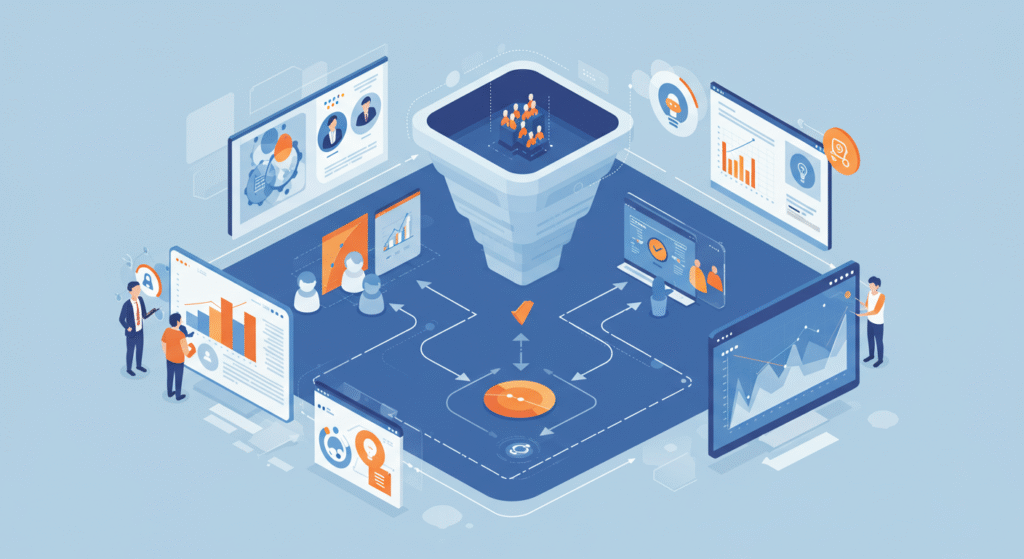
Digital marketing is the discipline of promoting and selling something through digital channels and measuring what that produced. The important part of the definition is at the end: without measurement it is not digital marketing, it is just digital advertising. This guide is written for small businesses and online stores, and instead of listing channels it explains which channel belongs at which point.
What does digital marketing actually cover?
In practice it is the sum of three separate jobs, and most businesses do one of them and then ask why nothing is working.
- Capturing demand: getting in front of someone already looking for you or your product. Search ads, shopping ads and SEO live here. This is the work that pays back fastest.
- Creating demand: introducing the product to people who are not searching yet. Social, video, partnerships and display. Slower to return, and the only work that raises the ceiling on your search volume.
- Keeping customers: bringing back someone who already bought. Email, SMS and segmentation. The cheapest sale you will ever make, and almost always the most neglected line.
The budget conversation happens between those three boxes. “Google or Meta” is usually the wrong question, because the two serve different boxes.

The channels, and what each is genuinely for
- Search ads: the highest-intent traffic there is. Someone typing “raincoat price” is close to a decision. Expensive, and the fastest channel to learn from.
- Shopping ads: usually the most efficient line for an online store. Also entirely dependent on your product data, because you do not write the ad copy, your feed does.
- SEO: the only channel with no cost per click, and the slowest to return. It is the wrong instrument for any plan shorter than six months.
- Paid social: the most scalable way to create demand. Creative quality decides more than the targeting settings do.
- Email and SMS: the channel with no cost per click. Segmentation quality matters far more than list size.
- Content: not a channel on its own, it is the raw material for the others. If a piece of content does not work in organic, in an ad and in an email, it probably was not needed.
A small budget, in order: which one first?
The most expensive mistake a business on a limited budget makes is opening six channels at once and gathering too little data in any of them to learn anything. The order is:
- Set up measurement. One purchase event, with the correct value, from one place. Until that is done, every unit of budget is spent blind.
- Capture your brand search. Someone already looking for you is your cheapest customer, and a competitor may be buying that search.
- Fix your product data. Shopping ads and organic product pages draw on the same data, so this single job improves two channels at once.
- Open the shopping campaign. With clean data this is usually the best-returning line in e-commerce.
- Set up remarketing. The person who added to basket and left is the warmest audience you have.
- Only then fund demand creation. By now there is an infrastructure ready to catch the interest it produces.
None of it means anything until measurement is in place
The most common picture we see: the ad platform reports 180 conversions and the accounts show 96 orders. That gap is not a performance problem, it is a measurement problem, and until it is closed every decision rests on data nobody should trust.
- One definition of a conversion. If the same purchase is sent from both the tag manager and the theme code, it is counted twice. This is the number one reason a platform and a ledger disagree.
- Send the real value. A fixed conversion value misinforms smart bidding and rewards your lowest-margin products.
- Send events server-side. Browser-only measurement loses more every year, and the loss is not evenly distributed, which is what breaks comparison between channels.
- Pick an attribution window and keep it. Comparing two months measured on different windows is comparing two different questions.
The e-commerce exception: product data is a marketing channel
Standard marketing guides never mention product data, because they were written for service businesses. On an online store the situation is reversed: the copy in your shopping ads, the content of your organic product page and your marketplace listing all come from the same data.
The practical consequence: a product with a thin title, the wrong category or an empty gtin goes invisible in three channels at once. And that is the one class of problem no campaign setting can fix.
To see where your catalog stands on this, start with a free feed analysis: give it your feed URL, more than 30 checks run per product, the catalog comes back graded A to F, and your source feed is never touched.
What the first 90 days should look like
- Month 1: set up and verify measurement, scan the product data, run a brand search campaign. Do not expect growth this month, you are laying a floor.
- Month 2: the shopping campaign, remarketing, and the first abandoned-basket email. The first meaningful lift in sales usually lands here.
- Month 3: creative built around the products that actually convert, the first content pieces, and segmentation. By now you know what works, so the investment is no longer blind.
The five most common mistakes
- Running ads before measurement exists. The result is never finding out which campaign worked.
- Keeping brand and non-brand search in one campaign. The resulting average flatters the account and tells you nothing.
- Switching campaigns off before they can learn. Automated bidding guesses on your behalf until it has seen enough conversions.
- Running the same creative for months. On social, the most common cause of decline is fatigue, not targeting.
- Treating the email list as one segment. Sending everyone the same campaign is the fastest way to train your best customers to wait for a discount.
Frequently asked questions
How much should a small business spend on digital marketing?
A fixed percentage would be misleading, because the right figure depends on your margin and your customer lifetime value. The useful question is: what is the most a customer can cost you to acquire? A budget set without knowing that ceiling is either too small to learn anything from or large enough to lose money.
Agency or in-house?
The line is not the number of channels, it is how often the work repeats. Work that recurs weekly (campaign maintenance, creative production, email flows) is cheaper in-house. Work that is setup and diagnosis (measurement architecture, data pipelines, feed remediation) suits an outside team better, because it gets done right once.
Does organic social still work?
As a reach mechanism it has weakened, but it still earns its place in two jobs: testing creative (finding out which message lands before paying to distribute it) and providing reassurance before purchase. People see the ad and check the profile, and an empty profile turns the sale away.
Where should I start?
By verifying measurement and looking at your product data. Both can be done inside a week, and both put every later decision on solid ground. If you want someone to set up the two together, see our consultancy services or just write to us.