The most common use of social media at an online store is maintaining a posting calendar that produces no sales. The problem is not the posting frequency, it is that nobody ever decided what social media is supposed to do. This piece separates the three jobs it actually does, then builds platform choice, content production, community management and measurement on top of that distinction.
1. The three separate jobs social media does in e-commerce
These three want different content, different frequency and different measures of success. They can share an account. They cannot share a metric.
- Creative testing: finding out which message lands before paying to distribute it. Success is measured in watch rate and saves, not in sales.
- Pre-purchase reassurance: people who see the ad check the profile. An empty profile, or one last updated six months ago, turns the sale away. Success here is not traffic, it is the profile existing.
- Customer service: most incoming messages are about delivery, sizing and returns. They are the highest-intent contacts you get, and usually the slowest answered.
A fourth job, direct organic sales, does not happen at most brands, and setting it as the goal damages the other three.

2. Platform choice: being everywhere is not a strategy
Being good on two platforms instead of mediocre on five is almost always the right call for a small or mid-sized team. Your product decides which two.
- Products sold on looks (clothing, home, cosmetics, furniture): the visual platforms. You can connect the catalog there, so the path to purchase is short too.
- Products that need explaining (technical, installed, expensive): video. The decision takes longer, so what to measure here is watch time rather than clicks.
- Products sold to businesses: professional networks. Second-tier for most retail brands, and first-tier the moment wholesale is part of the model.
- Closing a platform is also a decision. Deleting an account nobody has updated in six months beats leaving it open and visibly abandoned.
3. The catalog tells you what to make
Running out of content ideas is usually not a creativity problem, it is a habit of looking in the wrong place. Four sources are already sitting in your own data.
- The site search report: your customers’ real words. The top ten searches with no results are content subjects as they stand.
- The inbox: the tenth time the same question arrives is proof that the question should be a piece of content.
- Return reasons: mismatches in size, colour and expectation. Answering those up front improves the sale and the return rate at the same time.
- Most-viewed, least-sold products: there is interest and no persuasion. That list is the most productive place to aim content.
4. Production rhythm matters more than the calendar
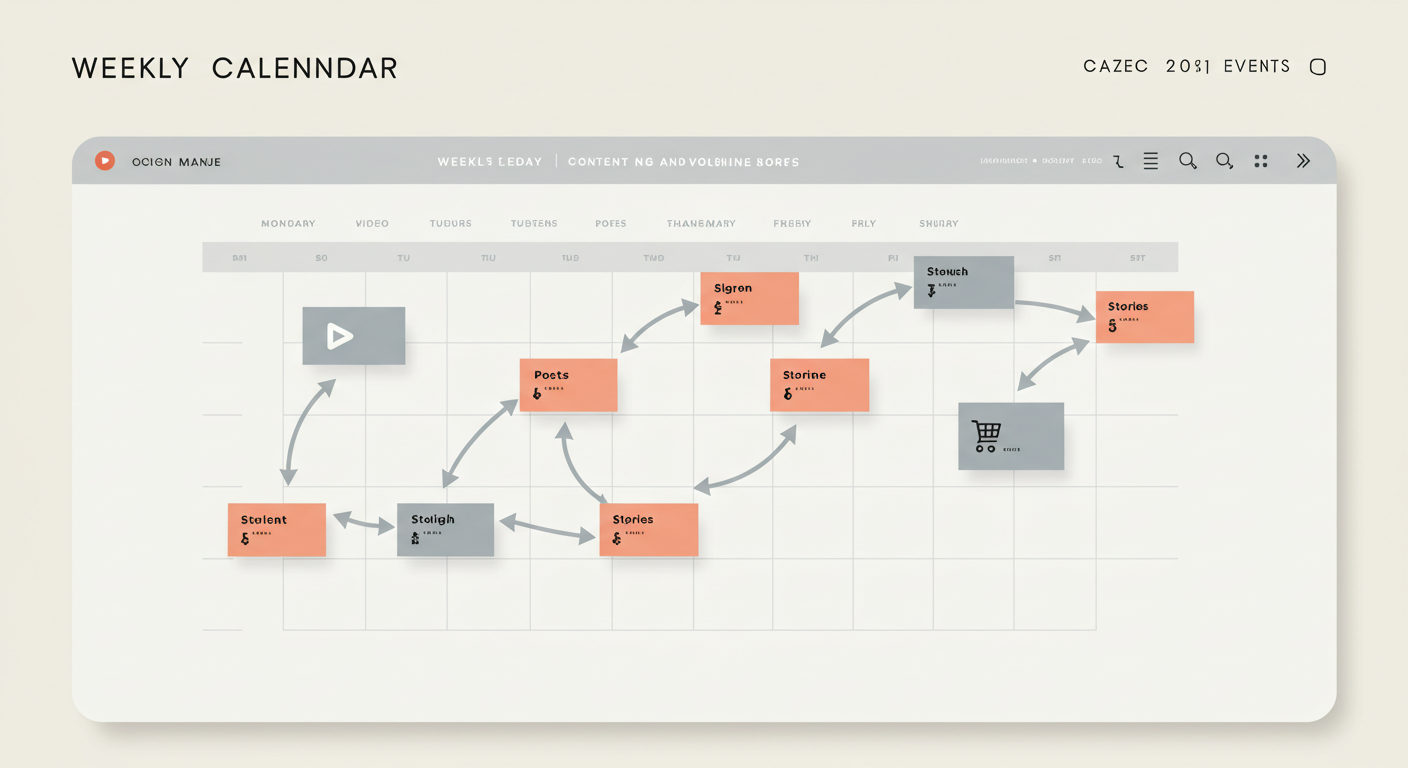
Most calendars collapse in week three because they were written without counting production capacity. The right order is to establish a rhythm you can sustain and then write the calendar to fit it.
- Shoot in batches. Producing a month of material in one shoot day is cheaper and more consistent than chasing content daily.
- Template the format. A recurring format builds a structure the audience recognises and cuts production time.
- Do not be afraid to post less. Two good pieces a week work better than daily mediocrity, and they do not exhaust the team.
5. Messages: the highest-intent contact you get
Someone who writes to ask about a product is far closer to buying than the average visitor browsing your site. The inbox is nonetheless usually the least resourced place in the operation.
- Measure response time. It is a far more meaningful social metric than follower count.
- Write answers to the three most frequent questions, and add them to the product page at the same time. A question arriving by message is a gap on the page.
- Count comments as the same inbox. An unanswered product question stays unanswered for everyone else reading it too.
6. Social commerce: the catalog connection and data quality
The moment you connect a catalog to a platform, your product name and image become your ad copy on that surface too. Which makes social commerce performance a product data job rather than a social media one.
- The title has to be short enough to read in a feed. A long title written for search gets truncated on the card.
- The image has to stand out in a feed. A product sitting small on white disappears while someone scrolls.
- Stock and price have to stay in sync. Routing people to a sold-out product costs both budget and trust.
You can measure where your catalog data stands on those three with a free feed analysis. The same data feeds the search and shopping surfaces, so a fix here pays back in more than one channel.
7. Measurement: not likes, so what?
Social is hard to measure because most of its effect cannot be directly attributed. That is a reason to choose the right metric, not a reason to skip measuring.
- Saves and shares indicate intent far better than likes do.
- Your brand search volume. The most honest number for whether social is doing the demand-creation job, and it is read in Search Console.
- Message volume and response time. This is what the sales funnel looks like on social.
- How organically strong content performs in paid. Reading the two together is how you measure the creative testing job.
8. The four most common mistakes
- Expecting direct sales from organic posts. The wrong goal produces the wrong content.
- Posting the same asset everywhere. Different formats, different safe areas, different viewing behaviour.
- Only announcing discounts. The fastest way to train your best customers to wait for one.
- Making follower count the goal. A bought or irrelevant audience actively harms you by lowering reach.
Frequently asked questions
How often should I post?
As often as you can sustain. The right answer depends on your team’s production capacity, and a calendar set above that capacity gets abandoned in week three. Irregular posting works worse than infrequent but regular posting.
Are creator partnerships worth it?
They are when chosen on how likely the audience is to buy your product rather than on follower count. A small, tightly focused account outperforms a large, unrelated one. To measure it, give every partnership its own link, otherwise you are guessing at the result.
Should social media be outsourced?
Production and planning can be. The inbox and the product knowledge should stay in-house. An account that answers a delivery or sizing question late and generically does more damage than one that does not answer at all.
If you want social planned alongside the ad and catalog side rather than separately from it, look at our consultancy side or write to us.